Victor Wastewater Treatment Facility


Victor’s Flushing Forward!
Victor is Taking Control of Our Water Future!
Right now, Victor’s wastewater is treated at the City of Driggs’ plant. But with Driggs planning a major upgrade—and uncertain costs on the horizon—Victor faced a crucial decision: keep sending our wastewater away or build our own treatment plant right here at home.
The City Council chose bold action. We’re building our own facility to take full control of how our water is treated, how projects are funded, and how operations are run. This means greater independence, smarter infrastructure, and stronger community resilience.
The project is already moving full steam ahead, with the city working closely with experts, lenders, and grant specialists to bring this vision to life. This is one of the most exciting infrastructure investments in Victor’s history—setting us up for a cleaner, fiscally responsible, and more resilient future.
Together, we’re flushing forward—building a Victor that’s ready for tomorrow.
City of Victor Filed Lawsuit Against City of Driggs
On March 5, 2026 The City of Victor has filed a lawsuit and demanded a jury trial against the City of Driggs, alleging years of contract breaches, chronic pollution violations, and financial misconduct tied to a shared wastewater treatment arrangement between the two neighboring cities.
Teton County, Idaho (March 5, 2026) – The City of Victor has filed a lawsuit and demanded a jury trial against the City of Driggs, alleging years of contract breaches, chronic pollution violations, and financial misconduct tied to a shared wastewater treatment arrangement between the two neighboring cities. The suit contends that Driggs repeatedly failed to operate its wastewater treatment plant in compliance with environmental and contractual obligations, forcing Victor to absorb higher costs while its residents’ wastewater was treated at a facility that could not meet legal standards.
“Driggs has repeatedly failed to meet its obligations under the wastewater agreement, and Victor is taking this step to protect our residents and our aquifer,” said Will Frohlich, Mayor of Victor.
According to the complaint, Victor and Driggs entered into a 2011 Inter‑City Agreement under which Driggs agreed to accept, convey, and treat Victor’s wastewater at Driggs’ upgraded wastewater treatment plant, which was to be “of sufficient size and capable” of treating anticipated flows from both communities in accordance with federal and state water‑quality requirements. Victor alleges that the upgraded plant has never been capable of consistently meeting its National Pollutant Discharge Elimination System (NPDES) permit limits and that Driggs has become a “perennial polluter,” discharging inadequately treated wastewater into Woods Creek, which flows into the Teton River, Henry’s Fork, Snake River, Columbia River, and ultimately the Pacific Ocean.
The complaint cites EPA and Idaho Conservation League records indicating thousands of permit violations and ranking Driggs’ facility among the worst‑performing wastewater plants in Idaho over multiple multi‑year periods. Victor further points to a 2018 EPA consent agreement and a 2025 federal consent decree that required Driggs to identify upgrades, complete construction, and bring its plant into compliance, alleging Driggs has repeatedly failed to meet deadlines, sampling requirements, and effluent limits and has not kept Victor adequately informed.
Victor also alleges that Driggs mishandled and misrepresented finances under the Inter‑City Agreement, including: failing to conduct required annual independent audits until 2024, not fully cooperating with that audit, and overbilling Victor for trunk line and plant debt service, as well as operations and maintenance costs. An independent auditor concluded that Victor has been overpaying on debt service related to a DEQ loan for wastewater facility and trunk line upgrades, and the complaint alleges that Driggs retained payments instead of properly applying them to debt service while also allocating non‑O&M expenses to the wastewater account.
The complaint outlines a breakdown in attempts to renegotiate the inter‑city relationship, alleging that Driggs delayed providing a new proposed wastewater agreement, then presented terms that would have required Victor to pay higher rates and a disproportionate share of costs stemming from Driggs’ own permit violations and necessary plant upgrades. Victor asserts that, in light of the escalating costs and ongoing non‑compliance, it has no choice but to pursue construction of its own wastewater treatment plant—estimated at approximately 35 million dollars for land acquisition, design, construction, and operation—which it claims is a direct consequence of Driggs’ breaches and lack of good faith.
In addition to wastewater and billing issues, the lawsuit includes a claim that Driggs breached a written mediation agreement between the cities and tainted the jury pool by disclosing confidential mediation communications to the media and in response to a public records request, allegedly to disparage Victor and misrepresent the value of a settlement proposal. Victor contends these disclosures damaged the city’s reputation, forced it to incur legal and public relations support costs, and violated confidentiality and good‑faith obligations expressly adopted in the mediation rules.
The complaint asserts causes of action for multiple breaches of contract (including failure to provide and operate a compliant plant, failure to comply with audit requirements, overbilling, and breach of a mediation agreement), breach of the implied covenant of good faith and fair dealing, and unjust enrichment. Victor seeks compensatory damages, disgorgement of amounts it alleges Driggs wrongfully retained, interest, attorneys’ fees and costs, and other relief deemed just and equitable, and it has requested a jury trial on all issues so triable.
Media Contact:
Jeremy Besbris
Victor City Administrator
208.274.7082 ext. 7
Many of you saw the news that the City of Victor has filed a lawsuit related to our long-standing wastewater agreement with the City of Driggs. Because wastewater service affects every household and business in Victor, I want to take a moment to explain why the City took this step.
Victor and Driggs share a close and long-standing relationship. Our communities are deeply connected through families, businesses, and daily life in the valley. Because of that relationship, legal action between the two cities is not something the City considered lightly.
Victor has historically relied on Driggs’ wastewater treatment facility to process the water that leaves our homes and businesses. This arrangement allowed both communities to share infrastructure and avoid duplicating expensive systems. Driggs is our neighbor, and for many years the cities worked together in that spirit.
Over time, however, several issues emerged that raised serious concerns for Victor residents and ratepayers. These included ongoing compliance problems at the Driggs treatment facility, federal enforcement actions requiring significant upgrades, and financial questions related to how costs under the intercity agreement were calculated and allocated.
Victor spent years attempting to resolve these concerns through cooperation rather than confrontation. City staff and elected officials participated in negotiations, mediation, and independent financial review in an effort to clarify costs and find a path forward that was fair to both communities without resorting to litigation.
Unfortunately, those efforts did not lead to a resolution.
Victor also proposed several options that would have allowed the two cities to continue working together through a shared wastewater facility under updated terms. These included proposals for a joint partnership agreement, a fair customer agreement, and other shared-use arrangements that could have allowed the communities to continue operating a common system. Those proposals were not accepted by Driggs.
Victor has made the commitment to build our own wastewater treatment facility. That decision allows our community to plan for a reliable, locally managed system going forward. However, choosing to build our own plant does not resolve the financial and contractual issues connected to the existing agreement with Driggs. Questions about past costs, billing practices, and shared infrastructure responsibilities still need to be addressed.
For that reason, the City concluded that legal action was the only remaining way to resolve these matters in a clear, transparent, and structured way.
Filing a lawsuit is never the first choice between neighboring communities. It is a last resort when other efforts have been exhausted. Our goal is to establish clarity and fairness so that Victor residents are not left carrying costs or obligations that are not consistent with the agreement between the cities.
While the legal process moves forward, Victor will continue focusing on the same responsibilities we have always had: protecting our aquifer, maintaining reliable infrastructure, and planning carefully for the city’s future wastewater needs.
Residents who would like to learn more can visit the City’s wastewater information page: https://victoridaho.gov/wwtf
To receive updates about the wastewater project and related decisions, you can subscribe to the Wastewater Matters community newsletter here: https://victoridaho.gov/newsletter-signup.
If you have questions or would like to share your thoughts, you are also welcome to contact the Mayor’s office directly at mayor@victoridaho.gov
Mayor Will Frohlich
City of Victor
Newsletters
To better educate the Victor residence, ratepayers, and community members the City of Victor has been working on a weekly newsletter series specifically regarding wastewater. Articles are listed below and new articles will be posted as they become available.
Wastewater Matters
For most of Victor’s history, wastewater has done exactly what it should: stayed out of sight and out of mind. It runs underground, quietly essential to public health and daily life.
Over the past year, however, it has moved from the background to the center of civic conversation.
This moment did not begin in 2025. Victor’s wastewater story stretches back more than 25 years. Before we discuss what comes next, it’s important to understand how we arrived here, what the engineering analysis concluded, and what has changed.
A Brief History of Victor’s Wastewater
Before 1999, wastewater in Victor was managed primarily through individual septic systems. As federal Clean Water Act standards tightened through the 1980s and 1990s, small natural-process systems struggled to meet modern discharge requirements. For a growing community, building and expanding a lagoon-based system required substantial land and capital.
On October 13, 1999, Victor entered into an agreement to send its wastewater to the City of Driggs for treatment. At the time, Driggs operated a lagoon system. The arrangement allowed Victor to maintain its local collection system while sharing treatment costs regionally.
In the late 2000s, regulatory pressure on Driggs increased due to repeated permit violations. In response, Driggs replaced its lagoon plant with a mechanical Multi-Stage Activated Biological Process (MSABP) facility in 2013. The two cities updated their inter-city agreement in 2011 to reflect this shift.
Despite that upgrade, compliance issues continued. In 2022, the U.S. Department of Justice filed a complaint against Driggs for thousands of permit violations. In January 2025, Driggs entered into a consent decree with the EPA requiring:
- A $400,000 penalty
- A major facility expansion and upgrade estimated at more than $30 million
This marked a turning point in the Victor–Driggs relationship. In early 2023, Victor initiated an independent audit that identified historical billing discrepancies. In October 2024, following Driggs's direction to increase rates to reflect projected treatment costs under the intercity agreement, Victor adjusted sewer rates accordingly. Those collected funds are currently being held in reserve and accrue interest. Facing ongoing regulatory uncertainty, limited operational control, and increasing financial exposure, Victor began evaluating whether continuing as a customer of Driggs was the right long-term path.
Why the Wastewater Study Was Commissioned
Victor commissioned an updated Wastewater Facilities Planning Study to:
- Evaluate the condition of its collection system
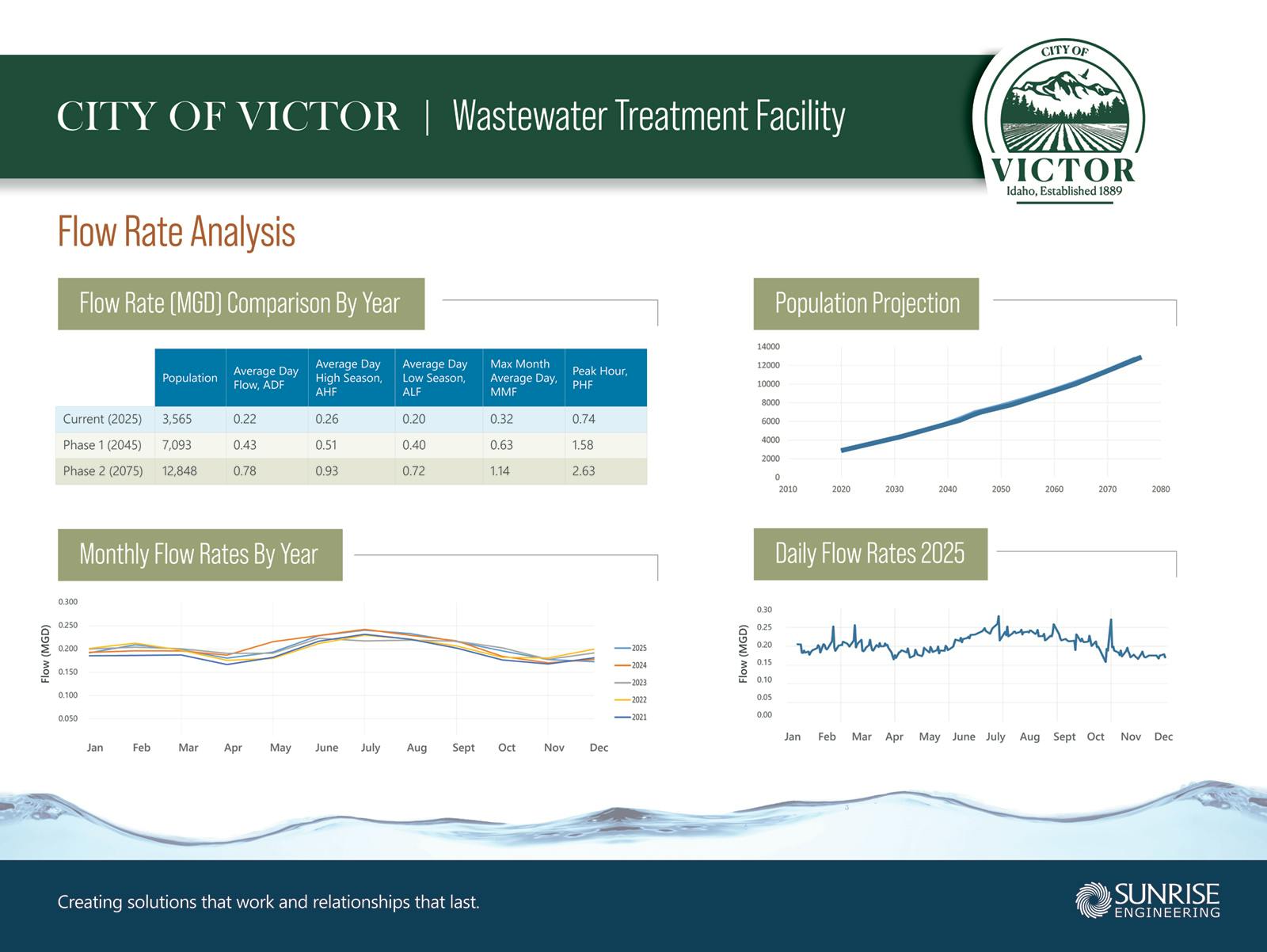
- Project future growth and flows
- Compare treatment alternatives
- Develop a long-term Capital Improvement Plan
At the time the study was prepared, several treatment alternatives were evaluated. However, land availability significantly constrained feasibility.
In 2024, the City examined a lagoon-based land application system. While simple and comparatively low-cost from a treatment-technology standpoint, engineering analysis determined that it would require leasing approximately 400–500 acres for irrigation. Securing and controlling that amount of land proved unworkable. As land availability conditions evolved and further analysis was completed, the City revisited mechanical treatment alternatives, including systems designed for surface discharge or rapid infiltration. In 2025, two additional factors influenced the reassessment of the Victor–Driggs partnership:
1: Contractual uncertainty: A draft replacement agreement proposed by Driggs did not clearly define accounting methodology or fund segregation. The proposed billing structure would have resulted in Victor ratepayers paying treatment rates higher than Driggs residents without clearly specified contractual protections. Future upgrades tied to the DOJ-mandated rebuild also raised concerns, as Victor has never had ownership or operational control of the facility. It would be inequitable for Victor to bear millions of dollars in costs stemming from design and operational decisions made solely by Driggs.
2: Off-site infrastructure costs: Capital improvements required between Victor’s northern lift station and the Driggs plant — commonly referred to as trunkline improvements — were estimated at approximately $20 million in potential exposure for Victor. Those costs significantly reduced the anticipated economy-of-scale benefit of remaining with a regional facility.
After reviewing the Keller Associates feasibility analysis, contract terms, and cost projections, the City Council unanimously voted in March 2025 to pursue development of a Victor-owned treatment facility.
The alternatives evaluated included:
- Remain with Driggs
- Construct a lagoon system
- Construct a mechanical plant with surface discharge
- Construct a mechanical plant with rapid infiltration
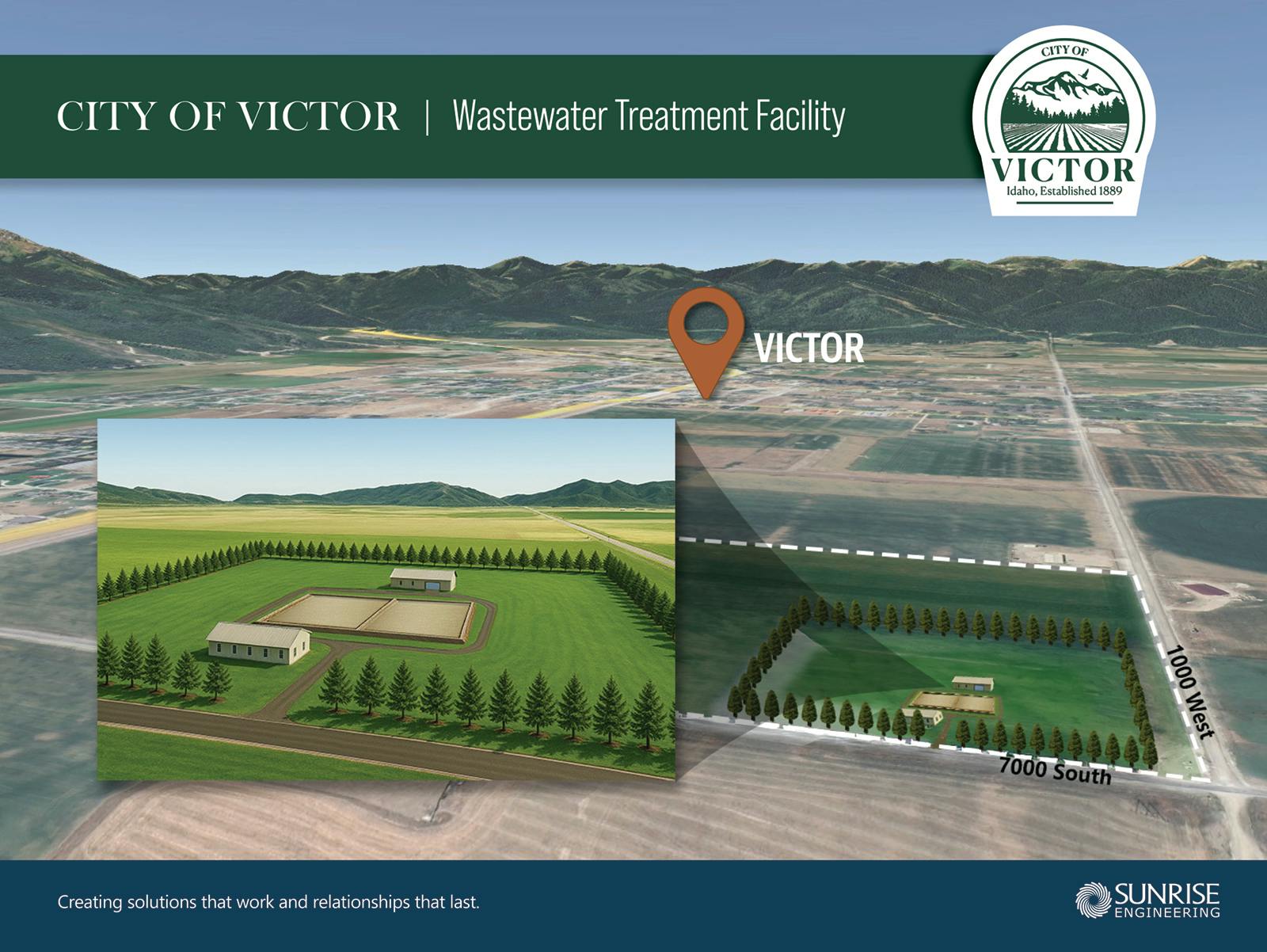
In August 2025, the City approved in open session the purchase of a 40-acre parcel for the future treatment site. All related annexation and rezoning actions were authorized during public meetings.
Driggs has agreed to continue treating Victor’s wastewater through at least January 2029 to allow time for design and construction.
What the Study Found
1. Victor’s Collection System
The engineering study concluded that Victor’s wastewater collection system is generally in good condition within city limits.
In 2024 dollars, approximately $23 million in capital improvements are identified between Victor’s northernmost lift station and the Driggs treatment plant. Under the existing intercity agreement framework, roughly $13 million of that total would be attributable to Driggs and approximately $10 million to Victor.
Driggs’ improvements are considered more immediate, as portions of their infrastructure are already operating at or above 85% capacity. Victor would need to upgrade its northern lift station in the near term (approximately $3 million), with additional improvements potentially deferred for up to a decade.
For planning discussions, a placeholder of approximately $20 million has been referenced as Victor’s potential exposure for off-site improvements, though that figure is subject to refinement depending on final cost allocation and agreement terms.
The full Capital Improvement Plan totals approximately $30.5 million over 50 years, with funding phased and prioritized. These are long-range planning estimates, not immediate expenditures.
Investment is required under any scenario. The difference is where those investments occur and who controls them.
2. The Regional Driggs Facility
Driggs’ facility has required repeated regulatory intervention and now faces another significant expansion under federal oversight. Victor’s continued participation would mean:
- Exposure to capital investments driven by another city
- Limited operational control
- Exposure to regulatory penalties and capital costs associated with permit violations. Under a draft replacement agreement proposed by Driggs, accounting methodology and fund segregation were not clearly specified, and treatment-related fines could have been incorporated into shared billing.
Those conditions have shaped the current reassessment in the inner-city relationship.
Why Mechanical Treatment Is Central to the Decision
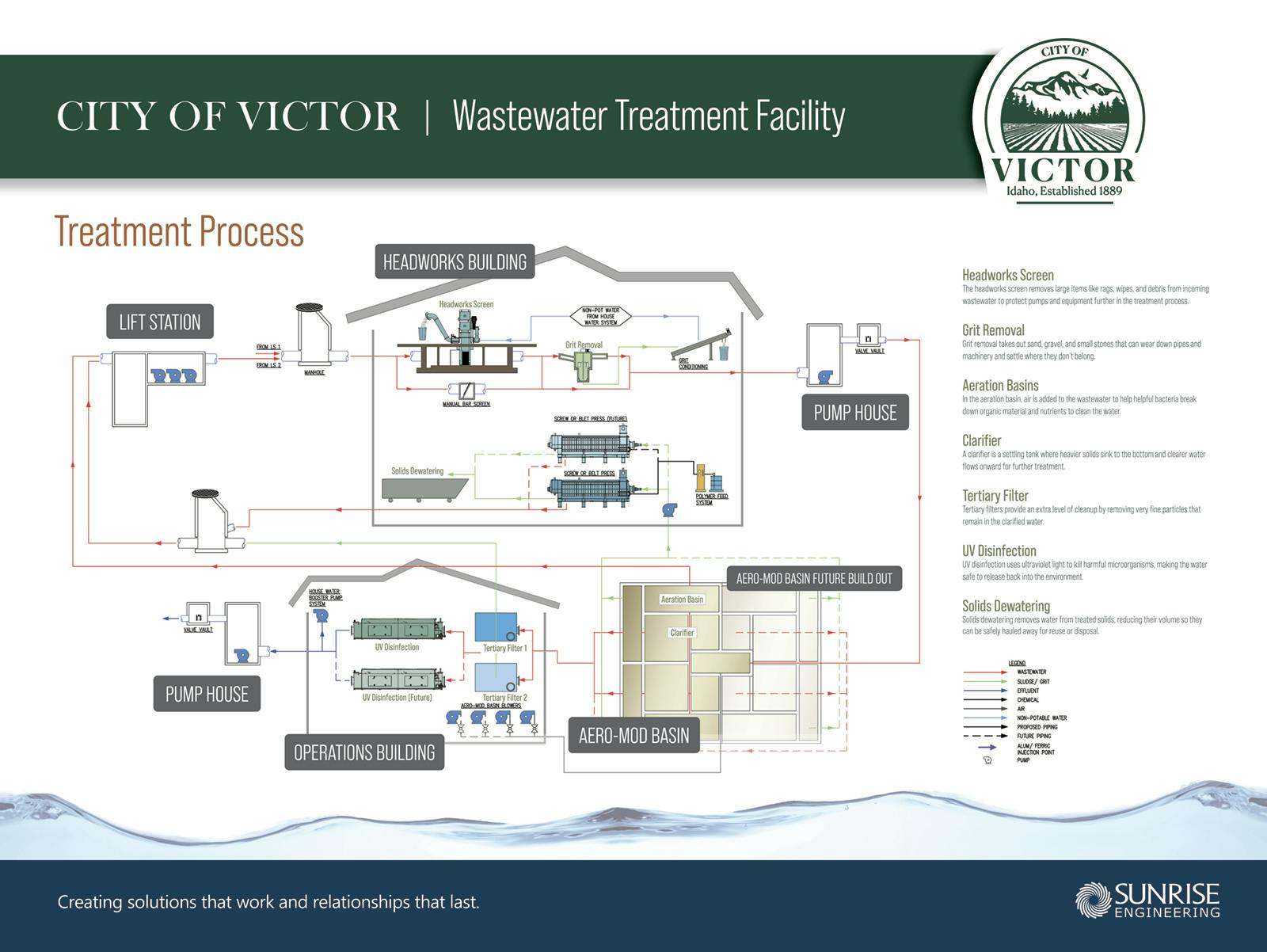
With land availability resolved, Victor is now evaluating an advanced mechanical treatment system engineered to meet higher treatment classifications and capable of producing Class A reclaimed water (please see About Class A water sidebar for more information).
The mechanical alternative allows for multiple discharge pathways, depending on DEQ permitting:
- Land Application: Treated water is applied to crops, with the permit requiring full crop uptake.
- Rapid Infiltration: Treated water is discharged into engineered infiltration basins and percolates into the aquifer.
- Surface Discharge: Treated effluent meeting high water-quality standards is discharged to surface waters.
Hybrid configurations are also possible depending on long-term operational strategy and DEQ permitting. This is a critical distinction. A modern mechanical system:
- Produces higher-quality effluent
- Offers more reliable treatment performance
- Provides direct local control over compliance and operations
It is not inexpensive. Advanced treatment is capital intensive.
The question is not solely upfront capital cost. It also includes long-term operating expense, staffing requirements, regulatory oversight, and governance control.
A shared Driggs facility was expected to require four full-time treatment operators. A Victor-owned mechanical facility is projected to require two part-time operators. Labor represents a significant component of annual operations and maintenance costs.
While cost-sharing at a regional plant might suggest proportional staffing expense, Victor must already employ personnel to operate its collection system. Remaining with Driggs would effectively add additional staffing obligations beyond those already required locally.
So, Victor now faces a structural choice: Continue investing in a regional facility with documented compliance challenges and expansion costs, or invest locally in a modern system designed to meet higher treatment standards with aquifer return potential.
Where We Are Today
Victor has transitioned from a customer model to planning for a local infrastructure asset under its own control. Council meeting links and staff reports related to the March and August 2025 decisions are cataloged in the City Council Meeting Links tab for public reference. Future wastewater actions will continue to be documented there.
Future updates will address:
- Ratepayer impact under different scenarios
- Governance structure implications
- Project timeline and financing considerations
Wastewater infrastructure is foundational to public health, environmental stewardship, and long-term community stability. The decision before Victor is not about avoiding investment. It is about determining where that investment should occur and under whose control it should operate. We encourage residents to stay informed and continue to ask hard questions.
What Is “Class A” Reclaimed Water?
Class A reclaimed water is the highest quality of treated wastewater Idaho allows to be reused for irrigation of parks, school grounds, athletic fields, golf courses, landscaped areas, certain commercial or industrial applications, and—under separate permitting—for groundwater recharge.
To achieve Class A, wastewater goes through advanced treatment and disinfection so that it meets strict state standards for clarity and for germs like bacteria, with daily monitoring to make sure those protections are maintained.
How Is It Different from a Lagoon?
Today, many small towns, including Driggs, use lagoon ponds, which mainly rely on time, settling, sunlight, and natural biological processes to clean wastewater.
A mechanical Class A system adds multiple layers of protection, including advanced biological treatment, filtration, disinfection, and continuous monitoring and controls, which makes the cleaned water more consistent and reliable in all seasons and during busy times.
What Can Class A Water Be Used For?
Class A water is non‑potable, meaning it is clean enough for high‑value uses like irrigating areas where people live, work, and play. With the right state permits and site conditions, Class A reclaimed water can be used for:
● Irrigating parks, school fields, golf courses, and landscaping
● Controlled land application on approved sites
● Groundwater recharge using specially designed rapid‑infiltration basins
● Other non‑drinking uses that Idaho DEQ reviews and approves case‑by‑case
Why This Matters for Victor Residents
Victor is a growing, semi‑arid community that relies heavily on local groundwater and wants to keep streams and aquifers healthy for the long term. Building a Class A facility helps Victor:
● Provide more reliable treatment than lagoons during cold snaps, storms, and peak‑tourist seasons
● Reduce the risk of future violations, fines, or rushed, expensive upgrades as water‑quality rules tighten
● Keep more water in the valley by creating the option to reuse water locally or recharge the aquifer instead of sending it all downstream
For residents, that translates to a more resilient system that supports homes, businesses, and community amenities while positioning Victor to adapt to Idaho’s prior-appropriation water system. As the state expands groundwater monitoring and curtailment enforcement, communities with junior water rights — like much of the Upper Snake River Plain — face increasing pressure during shortages. By treating water to higher standards and enabling permitted reuse or aquifer recharge, Victor may be able to pursue water-credit mechanisms that help offset future curtailments and preserve greater local flexibility.
Local Control of Our Water
With surface discharge, treated wastewater is released to a creek or river and quickly leaves local control. Class A treatment, paired with reuse or recharge, gives Victor tools to keep more of that water working for local parks, fields, and groundwater, under rules that are designed specifically to protect public health and the environment.
Regulatory Oversight and Safety
Any Class A reuse or recharge project must follow Idaho’s Recycled Water Rules and obtain a DEQ reuse permit that spells out required treatment, monitoring, reporting, and groundwater protections.
This is a regulated and inspected system, similar to how Victor’s drinking-water utility is already overseen. Each year, the City publishes a Water Quality Report detailing testing results and compliance with state and federal standards. These reports are publicly available on the Public Works page of the City website and are intended to give residents clear information about the safety and reliability of their water. Reuse and recharge systems operate under comparable monitoring, reporting, and regulatory requirements.
How Groundwater Recharge Works
If Victor pursues groundwater recharge, treated Class A water would be sent to shallow basins where it slowly soaks through the soil before reaching the aquifer.]
As the water moves through the soil, it gets additional natural “polishing” and filtration, and the city must monitor and report on this process to show that groundwater quality is being protected.
Summary
A lagoon cleans wastewater using basic natural processes and is more vulnerable to weather and growth pressures. A mechanical Class A system cleans wastewater to a much higher, more reliable standard using modern equipment and continuous monitoring, which opens the door to safe reuse in town and the potential to recharge our local aquifer under tightly regulated conditions.
Wastewater Investment: What It Costs the City and What It Means for Residents
Wastewater infrastructure is one of the least visible parts of city services, but it is among the most essential. As Victor moves forward with development of a locally controlled wastewater treatment facility, residents understandably want clear information about the financial side of the project.
This article focuses on one question: What will this cost the City?
A second article will explain what the project means for monthly sewer bills and rate structures.
Why This Conversation Is Happening Now
Over the past year, Victor explored whether a renewed regional wastewater partnership could be achieved. After extensive negotiation and mediation, no such agreement is currently available. With state and federal compliance obligations in place, the City is moving forward with development of a locally controlled wastewater treatment facility.
Wastewater infrastructure must be upgraded under any scenario. Regulatory timelines require a clear path forward, and engineering analysis has identified capital needs across the system over the next 5–50 years.
Infrastructure ages. Regulations evolve. Communities must invest in systems that protect water quality, public health, and long-term environmental stewardship.
Moving forward with a locally controlled facility also means local accountability. Victor will own and operate the infrastructure that serves its residents and will be responsible for planning, financing, and maintaining that system over time.
It is also important to understand that capital construction is only part of the total cost of operating a wastewater system. Facilities and pipes represent the upfront investment, but long-term operations, maintenance, staffing, and equipment replacement are equally important parts of providing reliable sewer service.
What “Project Cost” Actually Includes
When residents hear a number associated with a wastewater project, it typically refers to a planning-level capital estimate.
Municipal capital estimates generally include:
- Site acquisition (if applicable)
- Civil construction such as earthwork, tanks, and structures
- Mechanical and electrical systems
- Engineering design and permitting
- Construction management
- Contingency, typically 15–30% at the planning stage
Planning-level estimates include contingency because final construction bids have not yet been received. This is standard municipal practice and helps ensure early estimates are responsibly budgeted.
These early estimates also do not account for future inflation, which will be incorporated as projects move through design, bidding, and financing phases.
Wastewater Infrastructure Includes Two Major Parts
Wastewater systems consist of two major components:
- The treatment facility
- The sewer collection system
The sewer collection system includes the underground pipes and lift stations that move wastewater from homes and businesses to the treatment facility.
Over time, maintaining and upgrading the collection system may involve improvements such as:
- Lift station upgrades
- Pipe replacements or upgrades
- Lift station backup systems
- Other system reliability improvements
These types of investments are common for municipal sewer systems and are part of maintaining reliable infrastructure for decades to come.
Current Planning-Level Cost for a Victor Facility
The planning-level estimate for constructing a Victor-owned wastewater treatment facility has been referenced in the mid–$30 million range, including contingency.
This estimate reflects capital construction costs only. It does not include long-term operations and maintenance expenses and does not assume potential grant funding that may reduce the City’s financing needs.
Under this approach, the City would own and operate the facility, giving Victor long-term control over system operations, capital improvements, and regulatory compliance. Ownership also means the City is responsible for managing the infrastructure that protects local water quality and serves the community.
Understanding the Different Numbers You May Have Seen
Residents may have seen several different figures referenced publicly during discussions about wastewater infrastructure. These numbers refer to different parts of the system and different time horizons.
For example:
- A mid–$30 million estimate reflects planning-level construction costs for a Victor-owned treatment facility.
- A long-range Capital Improvement Plan estimate of roughly $30 million over 50 years reflects phased improvements to the sewer collection system under long-term growth assumptions.
- Other figures discussed publicly may refer to individual infrastructure components such as trunkline or pipe upgrades.
These figures describe different elements of the wastewater system, which is why they may appear different depending on the scope being discussed.
What Could Change the Final Cost
Planning-level estimates are an important starting point, but several factors influence the final cost of a project.
These include:
- Competitive construction bids
- Interest rates when financing is secured
- Potential grant or low-interest loan funding
- Final regulatory permit requirements
- Market conditions for labor and materials
As engineering design progresses, estimates become more precise. Final costs are determined after construction bids are received and financing terms are established.
Looking Ahead
Wastewater infrastructure investments are long-term decisions that affect environmental protection, community growth, and fiscal stewardship. By moving forward with a locally controlled treatment facility, Victor is taking responsibility for building and managing the infrastructure that serves its residents.
In the next issue of Wastewater Matters, we will focus on the second key question residents are asking: What does this investment mean for monthly sewer bills and household rates?
That article will explain how sewer rates are calculated and how infrastructure investments are financed over time.
In the previous issue of Wastewater Matters, we explained the planning-level capital costs associated with constructing a locally controlled wastewater treatment facility. A natural follow-up question residents are asking is:
What does this investment mean for monthly sewer bills?
This article explains how sewer rates are calculated, what the current rates cover, and what preliminary modeling suggests future rates could look like as the City moves forward with a new wastewater facility.
Current Sewer Rate Baseline
Victor’s sewer utility operates as an enterprise fund, meaning the system is funded by user fees rather than general tax revenue.
For FY2026, the proposed sewer fund budget is approximately $2.19 million, compared with $2.2 million in FY2025.
Victor currently has approximately 1,765 equivalent residential units (ERUs) connected to the sewer system. Based on the current budget and user base, the monthly sewer rate is $98.47 per month per ERU.
This rate supports the existing system, including sewer collection infrastructure, staffing, and treatment costs currently paid to the City of Driggs.
How Sewer Rates Are Calculated
Sewer rates are designed to cover the full cost of operating and maintaining the wastewater system. In general, sewer utility budgets include three major categories:
- Debt service, which repays borrowed funds used to construct infrastructure
- Operating costs, such as power, testing, equipment maintenance, and plant operations
- System maintenance and replacement, which ensures pipes, lift stations, and other infrastructure continue to function reliably over time
Sewer utility funds are restricted by law. Revenue collected through sewer bills can only be used to operate and maintain the sewer system. Sewer fees do not fund roads, parks, or other city services.
What Changes With a New Wastewater Facility
Under a locally controlled wastewater treatment facility, several costs within the sewer system would shift. The City would continue maintaining its existing sewer collection system and staffing structure. However, the current payment made to the City of Driggs for treatment services would be replaced by operating and financing costs associated with Victor’s own facility.
Preliminary modeling includes several major components:
- Existing sewer collection system costs
- Existing City staffing costs
- Plant operating expenses estimated at approximately $300,000 per year
- Debt service associated with constructing the facility
The plant operations estimate reflects operating expenses only. Salaries and capital financing are accounted for separately within the model.
Preliminary Rate Scenarios
Based on current planning-level estimates, preliminary modeling suggests the following potential rate range.
If the project cost were approximately $35 million, the modeled monthly sewer rate would be about $138.96 per month.
If the project cost were approximately $30 million, the modeled monthly sewer rate would be about $126.45 per month.
For context, the current rate is $98.47 per month.
These modeled scenarios represent an increase of roughly $28 to $40 per month, depending on final construction cost and financing terms.
The Role of Growth in the Rate Model
The rate model does not assume or rely on any future growth. Sewer rates must be projected using only the existing customer base to ensure they are sustainable without new development.
As additional homes and businesses connect to the system, the cost of infrastructure is distributed across a larger number of users, which helps moderate individual monthly rates.
How Grant Funding Could Reduce Rates
Grant funding can also play a significant role in reducing the cost borne by local ratepayers.
Based on the current model, every $1 million in grant funding could reduce monthly sewer rates by approximately $2.50 per household. $5 million in grant funding could reduce monthly rates by roughly $12.50 per month.
The City is actively pursuing grant and low-interest financing opportunities to reduce the overall cost of the project where possible.
What Happens Next
These figures are preliminary modeling scenarios, not final rates. Several factors will influence the final cost of the project and the resulting sewer rates, including:
- Final construction bids
- Interest rates at the time financing is secured
- Grant funding availability
- Final engineering design
Before any final financing decision is made, the City will present a detailed public rate model and discuss the financial implications in an open Council meeting.
Looking Ahead
Wastewater infrastructure is a long-term investment in community reliability, environmental protection, and public health. By moving forward with a locally controlled wastewater facility, Victor will take responsibility for operating and maintaining the infrastructure that protects local water quality and serves the community. As engineering and financing details become clearer, the City will continue sharing information with residents about the financial aspects of the project.
Now What? Moving Forward on Victor’s Wastewater Plan
Over the past week, many of you have seen the news that the City of Victor will not be moving forward with the Evans property as the site for a future wastewater treatment facility. I want to take a moment to speak to what that means, and just as importantly, what it does not.
First, this does not change the responsibility in front of us. Victor still needs a long-term wastewater solution. We are still working under external timelines. And we remain committed to delivering a system that is reliable, compliant, and serves this community for decades to come.
What has changed is one piece of how we get there.
The Evans parcel was identified as a strong option based on a range of engineering and siting criteria for the City’s clear water initiative. It aligned well with how our system functions today and offered efficiencies in infrastructure, operations, and long-term cost. It was never the only option, but it was the best one we had identified.
Before the Evans parcel was identified, City staff and our engineering team had already conducted high-level screening of several other potential sites. These were early evaluations using publicly available data and not detailed engineering studies, but enough to understand which locations might work and which clearly wouldn’t.
With the Evans parcel no longer an immediate solution, we are returning to that work.
What Happens Next
We are now re-engaging with our engineers to evaluate alternative sites more closely. As we do that, we will be applying the same criteria that guided our earlier work, including:
How much on-site and off-site infrastructure each option would require
Whether the site works with gravity flow and our existing system
Proximity to utilities such as sewer, water, and power
Environmental considerations, including floodplains, canals, waterways, and required setbacks
Compatibility with nearby homes and surrounding land uses
Long-term operational reliability and financial efficiency
At a practical level, there are only a small number of sites that meet these criteria. Based on what we know today, we are likely evaluating two to three viable options.
Each requires additional engineering and legal analysis before we can move forward with confidence. That process could take several weeks at the earliest and may extend further depending on what we learn.
In parallel, there are other factors affecting the overall project timeline. Engineering and design work beyond the preliminary stage is already expected to pause into the summer due to the judicial confirmation process. Once a new site is selected, portions of the engineering work will need to be updated to reflect that location.
What this means is that while this change may introduce some delay, the project was already operating within a timeline that included key decision points later this year.
Cost and Tradeoffs
The Evans parcel was optimal across nearly every factor, including cost. Other sites are more likely to require additional infrastructure, which can increase overall project cost.
As a general rule of thumb, each additional $1 million in capital cost translates to roughly $1 per month on a typical wastewater bill. That is one of the reasons site selection matters so much, and why we are approaching this next phase carefully.
While losing the Evans site for now is not ideal, it does bring a level of clarity. As we move forward, we will be working within more direct and established legal and regulatory frameworks for site selection. That allows us to focus more directly on feasibility, acquisition, and delivery.
The City worked with the property owners in good faith throughout the process. Ultimately, they made the decision not to proceed. Decisions related to personal financial matters are specific to the property owners and are best addressed by them. We respect that decision and the relationship we have built through this process.
On Regional Options
There has also been speculation that this change means Victor will return to a regional wastewater solution. At this time, we do not believe a regional solution solves for Victor's needs nor do we believe it would be anymore cost efficient. Previous discussions did not result in an agreement, and we have not received any indication that those conditions have changed.
Our responsibility is to continue advancing a solution that we can deliver. Our commitment is to keep moving forward, to do so thoughtfully, and to communicate clearly as decisions are made. We expect to provide a more formal update to the Council and the public in early June as this next phase of site evaluation progresses.
There is still work ahead. But the direction remains the same. Thanks for all your questions, comments, and support.
— Will Frohlich, Mayor
History
Below are links to past City Council Meetings related to wastewater discussion and actions and supporting information and data regarding wastewater.
Prior to 1999, the City of Victor, managed its wastewater through individual septic tanks. However, as environmental regulations under the federal Clean Water Act became more stringent in the 1980s and 1990s, these older, natural-process systems increasingly struggled to meet required discharge standards for pollutants. For growing communities like Victor, the cost of building a lagoon system and acquiring the necessary land for expansion became a significant financial and logistical burden.
This set the stage for a decades-long partnership with the nearby City of Driggs. On October 13, 1999, Victor signed an agreement to send its municipal wastewater to the Driggs facility for treatment. At the time, Driggs operated a lagoon-based plant. For years, this arrangement offered Victor a cost-effective solution, allowing the city to manage its local sewer collection system while cost sharing in the treatment with Driggs.
The landscape of this partnership began to shift significantly in the late 2000s. Driggs faced growing regulatory pressure from the U.S. Environmental Protection Agency (EPA) due to repeated violations of its discharge permits. In response, Driggs embarked on a major upgrade, replacing its lagoon system with a modern Multi-Stage Activated Biological Process (MSABP) mechanical plant in 2013. The two cities updated their original contract with a new inter-city agreement in 2011 to account for this change.
Despite the upgrade, Driggs' compliance issues persisted. In 2022, the U.S. Department of Justice filed a formal complaint against Driggs for thousands of permit violations, leading to a consent decree with the EPA in January 2025. As part of this settlement, Driggs was required to pay a $400,000 penalty and undertake another major facility expansion and upgrade, estimated to cost over $30 million.
This new financial pressure brought the Victor-Driggs partnership to a breaking point. An independent audit, initiated by Victor in early 2023, revealed significant historical billing discrepancies. Additionally, in October 2024, anticipating increased costs, the city implemented significant sewer rate hikes. Facing a lack of control over rising costs and management of the Driggs plant, Victor began to seriously consider its own independent system.
In March 2025, after reviewing a feasibility study by Keller Associates and evaluating multiple alternatives, Victor's City Council unanimously voted to "break up with Driggs". The alternatives considered included staying with Driggs, building a new lagoon system, or constructing a mechanical plant with either a surface discharge or rapid infiltration system. The decision was made to pursue the construction of a new plant, in which Victor would have control over legal compliance, costs, and management.
Following the decision, Victor took decisive steps toward self-sufficiency. In August 2025, the city entered a contract to purchase a 40-acre parcel of land to serve as the site for its new wastewater treatment facility. Driggs has agreed to continue treating Victor's wastewater until at least January 2029, allowing Victor time to complete construction of its new plant. This major infrastructure investment is a pivotal moment for Victor, shifting its wastewater management from a customer-model to a local asset under its own control.
Meeting links and staff reports for the March and August 2025 mentioned above are located in the City Council Meeting Links Tab below. It also includes all meetings where actions regarding the WWTF will be cataloged.
Teton Valley News Article about the Council Vote to begin the process of building a Wastewater Treatment Plant for the City of Victor.
Teton Valley News Article regarding the plan to purchase land for use of the WWTF.
All items below are linked:
By clicking on the date it will take you to the agenda
By clicking on the text it will take you to the staff report or materials
By clicking on the vote results it will take you to the minutes from that meeting.
2024
Victor City Council meetings with wastewater related items on the agenda.
April 18, 2024 - Task order for Sunrise Engineering for Wastewater Treatment Plant Feasibility Study - Approved 4-0
June 26, 2024 - Land Application Feasibility Study and Wastewater Treatment Facility Decision - Approved 3-0
2025
Victor City Council met 26 times in 2025, out of these meeting 14 of them had wastewater related items on the agenda.
January 22, 2025 - Engagement of Smith Currie and Hancock, LLP - Approved 4-0
February 26, 2025 - Wastewater Treatment Plan Work Session - No Action needed
March 12, 2025 - Wastewater Facility Planning Study - Presentation - Approved 3-0
March 27, 2025 - Victor Wastewater Facility Alternatives - Approved 3-0
May 14, 2025 - Service Agreement with Altura for Financial Consulting - Approved 3-0
May 22, 2025 - Spring Retreat Work Session WWTF Alt Delivery Methods - No Action Needed
July 9, 2025 - Sunrise Engineering Work Order for Professional Land Surveying - Approved 4-0
August 27, 2025 - Property Purchase and Sale Agreement - Approved 3-0
October 8, 2025 - Agreement with MSBT Law for Bond Counsel Services - Approved 3-0
October 8, 2025 - Proposal for Municipal Advisory Services - Zions Public Finance - Approved 3-0
October 14, 2025 - Fall Retreat Work Session WWTF Finance Methods - No Action Needed
October 22, 2025 - Professional Services Agreement for Engineer - Approved 3-0 (see RFP information in the drop downs below)
November 12, 2025 - Public Hearing for Judicial Confirmation - No Action Needed
November 12, 2025 - Contract for Municipal Advisory Services - Approved 2-1
November 13, 2025 - Public Hearing for Annexation and Rezoning of land for WWTF site (see application information in the drop downs below) - Continued to December 10, 2025
December 10, 2025 - Resolution R587 - Judicial Confirmation - Continued to January 14, 2026
December 10, 2025 - Public Hearing for Annexation and Rezoning of land - Continued to January 14, 2026
2026
Victor City Council meetings with wastewater related items on the agenda.
January 14, 2026 - Resolution R587 - Judicial Confirmation - Continued to January 28, 2026
January 14, 2026 - Public Hearing for Annexation and Rezoning of land - Approved 3-1
January 21, 2026 - Mediation with the City of Driggs
January 22, 2026 - Consideration of Mediation Agreement - No Agreement - No action taken
January 28, 2026 - Resolution R587 - Judicial Confirmation - Approved 3-1
February 25, 2026 - Reconsideration of Council Decision of LU2025-10 for Annexation and Rezoning Public Hearing - Denied
March 25, 2026 - Ratification of the First Amendment to the Purchase and Sale Agreement for 40 Acres - Approved
April 22, 2026 - Approval of Disbursement to Flying S Title and Escrow for the Purchase of Land - Approved
April 22, 2026 - Ratification of City of Victor; Complaint CV41-26-0062 - Approved
April 30, 2026 - Mutual rescission of purchase and sale agreement - Approved
April 30, 2026 - Repeal of decision to annex and designate initial zoning - Approved
April 30, 2026 - Ordinance O652 – An Ordinance of the City of Victor Excluding Certain Lands (De-annexing) from the City of Victor - Approved
In March 2025, Victor City Council voted to separate from Driggs and build a Victor plant. The following documents were presented.
Financials
Below there are links and data regarding basic and preliminary financials. This section with be updated as the City is awarded grand funding and more detailed bond and overall financial numbers are determined.
There is no clear financial winning scenario in this situation. The consent decree filed against the Driggs plant has a strict timeline and requirements that will result in tens of millions of dollars of expenditures. 20250115 Filed CD | MuniDocs | Driggs, ID | Municode Library
The costs associated with building a brand-new plant in Victor, an upgrade to a non-compliant plant in Driggs, or a combination of the two are extremely complex and vary in operational costs, debt service, and grant eligibility. Below are estimates of the various paths forward.
These estimates could change dramatically. It could be the difference of a single grant, an operational efficiency, a new hire, a change in interest rates, a large commercial building or development added to the system, or any number of other factors.
Victor and Driggs are actively pursuing grants from state and federal agencies and corporations to lower the cost of the build, as well as investigating alternative financing structures for better interest rates.
The two drivers of the monthly cost for users will be debt service and operations. City of Driggs is working on an operational budget to compare.
There are four options for moving forward with wastewater treatment:
-Alternative 1: Both Cities go their own direction. Estimated to be $16M for Driggs, $35M for Victor.
-Alternative 2: Victor and Driggs partner and do not accept the trunkline into the partnership (this would also be similar financially to a customer model). Estimated to be $34M combined, Victor could have a potential $20M in upgrades
-Alternative 3: Victor and Driggs partner and accept the JPA with trunkline into the partnership. Estimated to be $54M with upgrades included
-Alternative 4: Victor and Driggs partner and accept the JPA with trunkline into the partnership and make the necessary improvements for Class A Discharge (the highest environmentally conscious discharge). Estimated to be $60M
Driggs Debt Service
Driggs Debt Service (not including any grants, operational expenses, or collection expenses, also does not include dredging expenses). These are simple calculations based on a 30 year, 4% amortization. This is a possible route and interest rate using the Idaho Bond Bank. It is possible that the City of Driggs may get better financing offers but it would likely come with BABA and other provisions, increasing the costs. City of Driggs has reached out and expressed they are interested in a twenty-year amortization. If a twenty year amortization is chosen, the payments on each option increase by approximately $250k/yr.
Debt Service for only City of Driggs (not including 2016 debt)
Alternative 1, Only Driggs, $916,637/yr
Alternative 2, JPA no trunkline, $973,927/yr
Alternative 3, JPA w trunkline, $1,546,826/yr
Alternative 4, JPA with Class A w Trunkline, $1,718,695/yr
Victor Debt Service
Victor Debt Service (not including any grants, operational expenses, or collection expenses, also does not include dredging expenses at the Driggs facility).
These are simple calculations, based on a 30 year 4% amortization, a likely financing option with the Idaho Bond Bank. The second, third, and forth alternatives are with the 4% loan shared with Driggs above.
Debt Service for only City of Victor (not including 2016 debt)
Alternative 1, Only Victor, $2,005,144/yr
Alternative 2, JPA no trunkline, $2,119,724
Alternative 3, JPA w trunkline, $1,546,826
Alternative 4, JPA with Class A w Trunkline, $1,718,695
Victor's payment is higher for the no trunkline because in Alternative 2, Victor is paying for trunkline capital expenses
After Driggs' Mayor August attended the Victor council meeting on December 10, councils directed staff from both cities to create a Treasurer's Reports outlining the financial discrepancies and issues surrounding the wastewater treatment plant.
On December 16, 2025, ahead of the Driggs' council meeting, the following reports and documents were sent to both Victor and Driggs' city councils.
After December 16th, both cities agreed to go to mediation. Staff and council are working to confirm a date and a mediation firm.
Victor Treasurer Report with Driggs' comments
Driggs Treasurer Report with Victor's comments
2011 Driggs - Wastewater agreement
LGIP investment rates (for interest calc)
Driggs' payment confirmation (for payments 2014-2016)
Zollinger lift stations - showing Driggs collection system costs
Q4 23 bill showing credit for operational overcharges
General Outreach
Below are links to past tours, open houses, letters to the editor, op-eds, and press releases that have been provided regarding wastewater. This will be updated as more information becomes available.
The City of Victor offered a Site Visit to Garland, Utah’s Wastewater Treatment Facility!
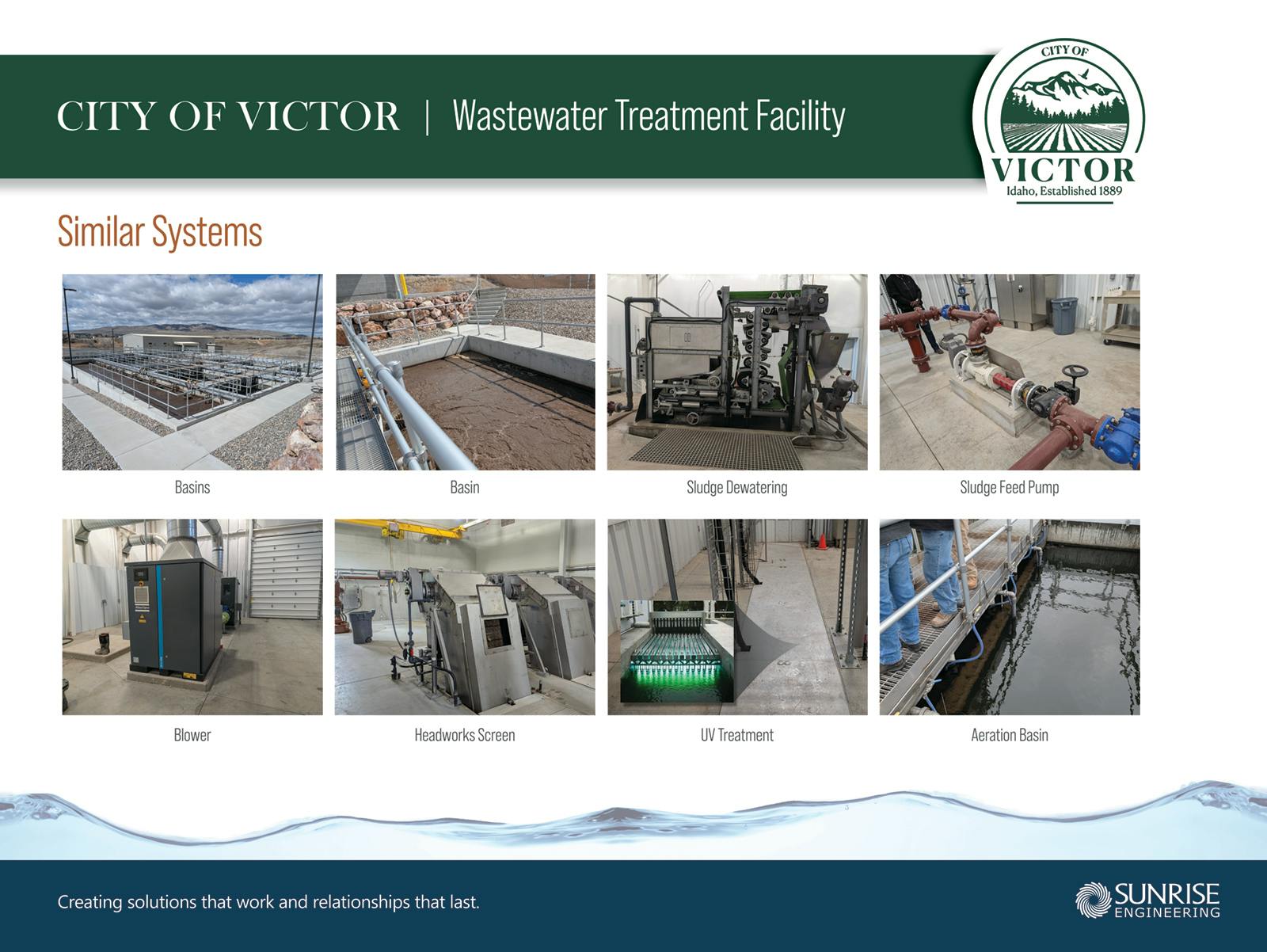
The City of Victor invited community members to tour the Garland City Wastewater Treatment Plant on Friday, December 5 — an innovative facility designed by Sunrise Engineering, the same firm leading design and construction oversight for Victor’s proposed new plant.
Reasons for the visit!
The Garland facility offers a real-world look at what Victor’s project could feel like in scale, design, and performance. It features:
✅ Similar size and treatment process
✅ Advanced nitrogen & phosphorus removal
✅ Energy-efficient, expandable design
✅ Thoughtful siting near residential areas
✅ Lessons learned on permitting and construction
Garland’s 7,300 sq ft facility uses AeroMod’s Sequox® Process — treating 0.45 million gallons per day while meeting strict nutrient limits. Despite COVID-era challenges, Sunrise helped the city complete the project under budget through value engineering and close coordination with USDA Rural Development.
City officials and engineers touring the Garland Wastewater Treatment Facility this past spring. The facility is located near residential areas, demonstrating how thoughtful design can minimize impacts and integrate well within the community.
Hello Teton Valley! I would like to give thanks to the City of Driggs for allowing me to speak during their meeting on December 16th, 2025. I would also like to thank the Driggs City Council for all voting in favor of agreeing to mediation between the two Cities. I wanted to further share with the public what I presented to the Driggs City Council on the 16th for those who were unable to attend.
- Mayor Frohlich
Minutes from the 12/16/2025 City of Driggs City Council Meeting
Driggs City Council Meeting – 12/16/25 – Agenda item – Victor Waste Water Treatment Plant Mediation Proposal
Hello Council and Mayor - Thank you for letting me speak tonight.
I appreciate the opportunity to provide additional context regarding the matter before us and am happy to answer any questions you may have.
First, I would like to thank the Council for your service and dedication. As the powerful decision-making body, your role is critical. It is the responsibility of Mayors and City Staff to support your decisions and provide the necessary information to guide you through the decision-making process. Sound decisions are built on solid information, and complex issues become more manageable when all data is present.
I would like to address the working relationship between our two cities. Our communities have a long history of collaboration that predates our respective administrations, continues today, and will endure long after we leave office. It is essential that all of us maintain a professional and respectful approach in our interactions.
To provide a brief background on the current situation: As is well known, the existing WWTP has experienced issues since its inception. At the time the plant was designed, the City of Victor expressed opposition to the chosen design, as it involved an unproven option for our location. But Driggs’ Engineers said it would work as promised.
As a User, Victor was aware of existing issues but did not know the full extent of the problems. We later learned that multiple concerns and actions had been raised by the DOJ (Department of Justice), EPA (Environmental protection Agency), DEQ (Department of Environmental Quality), and other entities. We only received formal notification from Driggs of the DOJ lawsuit and resulting Consent Decree after the terms of the Consent Decree had been negotiated between Driggs and the Department of Justice.
Unfortunately, Victor often learned about these significant issues years after the problems arose through public sources, such as social media and newspaper articles, rather than directly from our partner. Victor continues to learn through third parties that Driggs is in continued violation of the Consent Decree.
In hindsight, and per our agreement, a proactive audit should have been done annually. This was not agreed to on multiple occasions.
Years ago, I instructed the Victor City Administrator to begin working with the Driggs City Administrator to address the issues and align on a plan. Following the Driggs City Administrator's departure, we learned that Driggs was unaware of these recent conversations and communications and needed time to investigate further.
A third-party independent audit was eventually agreed upon by both cities. The scope was intentionally narrow to control costs. Even within this small sample size, the audit found several discrepancies. It’s important to clarify that the audit was conducted by an independent third-party firm with no ties to either city. The financial data used in the review came primarily from Driggs, since Driggs owns the facility and maintains all related financial records. Because the audit relied on Driggs’ own documentation, the findings reflect that information — not any outside influence from Victor. To that end, I want to emphasize the audit firm was selected in part because they had no prior relationship with either city.
Following the initial audit, we requested an additional, broader audit to review a longer time frame and address outstanding issues, but this request was denied on multiple occasions. Driggs has only recently consented to a broader audit but admitted that they do not possess records needed for the audit.
Additional meetings were held between the two Cities, but these discussions concluded without a resolution. Victor’s concerns regarding financial discrepancies were dismissed or minimized and, on several occasions, Victor was directed to ‘GO BUILD YOUR OWN PLANT,’ among other discouraging comments.
After two plus years of having our concerns dismissed or minimized, Victor engaged outside counsel, Smith Currie, to advise us on the outstanding issues and to help us negotiate a mutually beneficial inter-city agreement for wastewater treatment services. However, the new agreement presented to Victor proposed reduced involvement while simultaneously asking us to increase our financial contribution. We would also maintain zero input or control over the plant’s design or operations. And would allow Driggs to pass on its costs associated with the Consent decree disproportionately to Victor users for Driggs’ benefit.
As a point of clarification, Smith Currie is not advising us on whether to build a new plant. Regarding the tone of the letters/requests sent—it is fair to say they reflected the frustration and urgency felt at the time. Victor desperately wanted and desperately wants its financial and legal concerns to be taken seriously. Following multiple failed attempts at negotiation, Driggs gave Victor a deadline last Spring of just over a week to decide whether to remain under the current agreement or commit to building a new plant.
The Victor City Council voted unanimously to proceed with building our own plant. As this process continued, public interest grew, leading to encouragement for one final attempt to work with Driggs. We have spent weeks seeking confirmation from Driggs on what options the DOJ is willing to consider. To date, we have not received a definitive answer, and we now face hard deadlines. It has been confirmed that the DEQ, not the DOJ, will support a joint plant, which obviously we already know. (Driggs’ City Attorney did confirm during the meeting that the DOJ is open to JPA discussions).
During our Council meeting last week, Mayor August stated that if we choose to advance this discussion, Victor must lead the effort. In response to that request, we moved swiftly to send a letter requesting mediation as a starting point. This letter was sent to Driggs on Friday.
Regardless of the decision made tonight, your focus must be on what is right for the rate payers of Driggs and the environment, just as our focus is on what is right for the rate payers of Victor and the environment. Please know that I hold no personal ill will toward any member of this body, and that has been my perspective throughout this entire process.
Letter to the Editor: A Responsible Path Forward for Teton Valley
Dear Editor,
I want to extend my sincere thanks to the City of Driggs and its City Council for the opportunity to speak during their December 16th meeting, and for their unanimous vote in favor of entering mediation with the City of Victor regarding wastewater treatment services. This decision marks a meaningful step toward resolving longstanding issues in a constructive and cooperative manner.
Victor and Driggs share a history of collaboration, and while our cities may be exploring different paths forward, our shared commitment to the health of our communities and environment remains unchanged. Mediation offers a chance to address unresolved legal and financial concerns with transparency and mutual respect—not necessarily to preserve the status quo, but to ensure that whatever path we choose is grounded in fairness and sound decision-making.
Victor has consistently advocated for accountability throughout this process. We’ve worked to understand the full scope of the challenges facing the current wastewater treatment system and have taken steps to ensure our ratepayers are protected. Our decision to pursue the development of our own facility was not made lightly, but reflects what we believe to be the most responsible and cost-effective solution for our community.
That said, we remain open to dialogue. Mediation is not about winning or losing—it’s about working together to find clarity, resolve outstanding issues, and determine the best course forward for both cities. Whether that leads to a renewed partnership or a respectful separation, our goal is to ensure that the outcome serves the long-term interests of our residents and the environment we all share.
Thank you to everyone in Teton Valley who has engaged in this conversation. Your voices matter, and your continued involvement will help shape a sustainable future for our region.
Sincerely,
Will Frohlich
Mayor, City of Victor
Teton Valley News publication of Letter to the Editor December 23, 2025
Over 30 people attended a public open house held on January 14, 2026 with the City's contracted engineer. Documents shared at the open house are linked below.
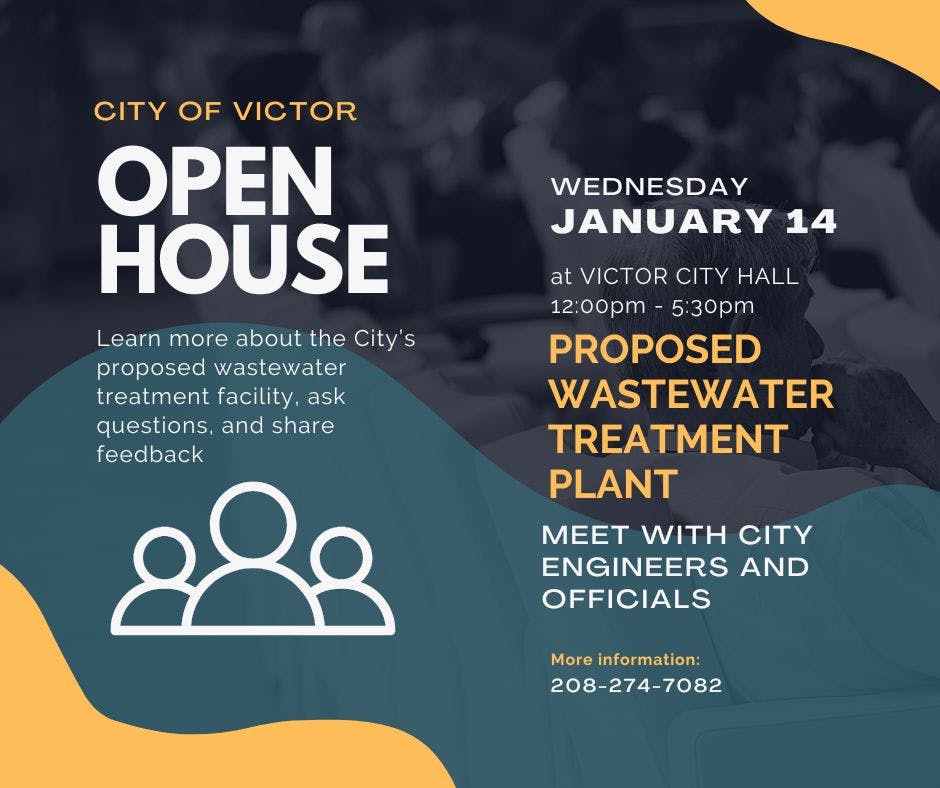
City of Victor Advances Plans for Independent Wastewater Treatment Facility
The City of Victor is moving forward with plans to construct an independent wastewater treatment facility to ensure reliable service for residents and meet all regulatory obligations. This step follows a decision by the Victor City Council in March 2025 to pursue separation from Driggs’ treatment facility.
Before implementing this plan, Victor formally invited the City of Driggs to participate in mediation aimed at achieving an equitable and sustainable resolution to issues with the shared wastewater system issues that have become increasingly evident in recent years.
Victor’s priorities have consistently included preserving a regional solution where possible and ensuring fairness for Victor ratepayers—whether through a revised cost-sharing structure, a customer agreement, or an alternative governance framework.
The decision to re-engage through mediation reflected the Council’s belief that public input deserves more than acknowledgment—it requires action, including renewed efforts to seek a fair and collaborative resolution. Mediation was conducted under standard confidentiality provisions, which are common practice to allow candid discussion and create space for compromise. Despite these efforts, the process did not produce a viable path forward.
Accordingly, Victor has begun planning for independent wastewater infrastructure to meet legal obligations and provide reliable service to residents.
Council remains committed to transparency, environmental stewardship, and constructive engagement with our residents and neighbors. To that end, the City has engaged an engineering firm with the stated intent of building a Class A facility, ensuring treated water will meet or exceed the highest standards.
We encourage residents to stay engaged as planning moves forward. Watch for invitations to open houses, public forums, and other opportunities to learn more about the project and help shape its development. Together, we can deliver a facility that reflects community priorities and serves Victor for generations to come.
Agendas for council meetings and supporting materials can be found at https://victoridaho.gov/boards-commissions-committees/city-council/city-council-meetings , and materials related specifically to the WWTP project can be found at https://victoridaho.gov/wwtf .
Op-Ed: Why Building Our Own Wastewater Facility Is the Right Move for Victor
By Mayor Will Frohlich
What kind of community do we want to be in 10 years? One that relies on a broken system and hopes for the best—or one that takes responsibility for its future? That’s the question behind Victor’s decision to build our own Class A wastewater treatment facility.
For two decades, we’ve sent our wastewater 10 miles north to a plant that has struggled with repeated failures, permit violations, and now a full rebuild just to meet the bare minimum. We’ve paid nearly half of their improvement costs, and even then, we were overbilled. After all that, the system is still polluting our water.
Victor deserves better. Building our own Class A facility means we stop relying on a broken system and start doing things right. This isn’t about growth—it’s about responsibility. It’s about clean water, protecting our environment, and ensuring we have dependable infrastructure for decades to come.
We’ve already engaged one of the most qualified engineering teams in the region and are working closely with the Idaho Department of Environmental Quality to make sure this facility meets the highest standards. As the design moves forward, residents will have opportunities to learn more and share input. This is a big step toward a reliable, locally managed solution that reflects our community’s values.
We’re moving quickly, but we’re not cutting corners. By using a construction method that allows design and planning to happen in parallel, we can stay on schedule without sacrificing quality. We expect to close on the land next month and could see early site work this summer. Our engineers believe the plant could be online within three years—a few months ahead of Driggs’ January 1, 2029 deadline for independence.
And yes, we’ve done our homework on costs. The $35 million estimate isn’t just a guess—it’s based on detailed engineering work, real pricing from suppliers, and includes a conservative 20% contingency. We even rounded up for good measure. On top of that, our delivery method gives us a Guaranteed Maximum Price, so we have strong cost controls in place. This is essential infrastructure, and we’re committed to doing it right and responsibly.
This isn’t about personalities or politics—it’s about infrastructure and responsibility. Driggs has been a partner for decades, and we appreciate that relationship. But the reality is their system has struggled for years, and now both cities need solutions that work. Building our own facility isn’t a disagreement—it’s a decision to protect our water, our environment, and our future. I invite every resident to stay engaged, ask questions, and share input as we move forward. Together, we’re building something that will serve our community for generations.
Action Steps
Below are several of the approved, pending, and future actions steps towards building a new wastewater treatment facility. This list does not include every voted action item or contract that requires Council approval. See City Council Meeting List above for links to all meet agendas, staff reports, and minutes regarding wastewater related items. This will be updated as these action steps work their way through their required processes.
The Request for Qualifications for Engineering Design Services for a New Wastewater Treatment Plant is closed. A Selection Committee reviewed all submissions and rank them. They presented their ranking to Council Council for selection and contract. Sunrise Engineering has been contracted to be the engineer for this project.
October 22, 2025 Professional Services Agreement by City Council
The City was under contract for the purchase of land outside City limits but is immediately adjacent. Staff prepared the required materials for the Annexation/Rezoning application. The portion of the site to be purchased by the City was requested to be CIV zoning district, the owner requested RS-16 for the remainder of the property.
LU2025-10 Application Material
October 16, 2025 - Planning and Zoning Commission Public Hearing
November 13, 2025 - City Council Public Hearing
December 10, 2025 - City Council Public Hearing
January 14, 2026 - City Council Public Hearing
The Annexation and Zoning was approved. 3-1
Ordinance O645 - Recorded as Instrument #294126
Annexation Plat - Recorded as Instrument #294127
Shortly before closing the owner requested a mutual recission of purchase agreement and deannexation of he property.
April 30, 2026 - Special Meeting - Deannexation
Deannexation approved 4-0
Ordinance O652 - Recorded as Instrument #
On October 8, 2025 City Council voted to approved (3-0 ) an agreement with MSBT Law for Bond Counsel Services . On November 12, 2025 City Council held a public hearing for Judicial Confirmation . On January 28, 202 6 City Council voted to approve (3-1) Resolution R587 - Judicial Confirmation to send the City's request for judicial confirmation to the courts for review. The Judicial Hearing was scheduled for April 7, 2026.
The hearing has been postponed. The new date has not yet been determined.