


Victor Wastewater Treatment Facility


Victor is currently engaged in mediation conversations with the City of Driggs to determine whether Victor will continue to send its wastewater to Driggs, combine forces with a joint powers partnership, or separate and build two separate plants. More information will be posted here as it becomes available.
Open House
Wednesday, January 14 12PM-5:30PM at Victor City Hall
Letter to the Editor: A Responsible Path Forward for Teton Valley
Dear Editor,
I want to extend my sincere thanks to the City of Driggs and its City Council for the opportunity to speak during their December 16th meeting, and for their unanimous vote in favor of entering mediation with the City of Victor regarding wastewater treatment services. This decision marks a meaningful step toward resolving longstanding issues in a constructive and cooperative manner.
Victor and Driggs share a history of collaboration, and while our cities may be exploring different paths forward, our shared commitment to the health of our communities and environment remains unchanged. Mediation offers a chance to address unresolved legal and financial concerns with transparency and mutual respect—not necessarily to preserve the status quo, but to ensure that whatever path we choose is grounded in fairness and sound decision-making.
Victor has consistently advocated for accountability throughout this process. We’ve worked to understand the full scope of the challenges facing the current wastewater treatment system and have taken steps to ensure our ratepayers are protected. Our decision to pursue the development of our own facility was not made lightly, but reflects what we believe to be the most responsible and cost-effective solution for our community.
That said, we remain open to dialogue. Mediation is not about winning or losing—it’s about working together to find clarity, resolve outstanding issues, and determine the best course forward for both cities. Whether that leads to a renewed partnership or a respectful separation, our goal is to ensure that the outcome serves the long-term interests of our residents and the environment we all share.
Thank you to everyone in Teton Valley who has engaged in this conversation. Your voices matter, and your continued involvement will help shape a sustainable future for our region.
Sincerely,
Will Frohlich
Mayor, City of Victor
Hello Teton Valley! I would like to give thanks to the City of Driggs for allowing me to speak during their meeting on December 16th, 2025. I would also like to thank the Driggs City Council for all voting in favor of agreeing to mediation between the two Cities. I wanted to further share with the public what I presented to the Driggs City Council on the 16th for those who were unable to attend.
- Mayor Frohlich
Please visit the City of Victor’s link here for additional information - https://victoridaho.gov/wwtp
Driggs City Council Meeting – 12/16/25 – Agenda item – Victor Wast Water Treatment Plant Mediation Proposal
Hello Council and Mayor - Thank you for letting me speak tonight.
I appreciate the opportunity to provide additional context regarding the matter before us and am happy to answer any questions you may have.
First, I would like to thank the Council for your service and dedication. As the powerful decision-making body, your role is critical. It is the responsibility of Mayors and City Staff to support your decisions and provide the necessary information to guide you through the decision-making process. Sound decisions are built on solid information, and complex issues become more manageable when all data is present.
I would like to address the working relationship between our two cities. Our communities have a long history of collaboration that predates our respective administrations, continues today, and will endure long after we leave office. It is essential that all of us maintain a professional and respectful approach in our interactions.
To provide a brief background on the current situation: As is well known, the existing WWTP has experienced issues since its inception. At the time the plant was designed, the City of Victor expressed opposition to the chosen design, as it involved an unproven option for our location. But Driggs’ Engineers said it would work as promised.
As a User, Victor was aware of existing issues but did not know the full extent of the problems. We later learned that multiple concerns and actions had been raised by the DOJ (Department of Justice), EPA (Environmental protection Agency), DEQ (Department of Environmental Quality), and other entities. We only received formal notification from Driggs of the DOJ lawsuit and resulting Consent Decree after the terms of the Consent Decree had been negotiated between Driggs and the Department of Justice.
Unfortunately, Victor often learned about these significant issues years after the problems arose through public sources, such as social media and newspaper articles, rather than directly from our partner. Victor continues to learn through third parties that Driggs is in continued violation of the Consent Decree.
In hindsight, and per our agreement, a proactive audit should have been done annually. This was not agreed to on multiple occasions.
Years ago, I instructed the Victor City Administrator to begin working with the Driggs City Administrator to address the issues and align on a plan. Following the Driggs City Administrator's departure, we learned that Driggs was unaware of these recent conversations and communications and needed time to investigate further.
A third-party independent audit was eventually agreed upon by both cities. The scope was intentionally narrow to control costs. Even within this small sample size, the audit found several discrepancies. It’s important to clarify that the audit was conducted by an independent third-party firm with no ties to either city. The financial data used in the review came primarily from Driggs, since Driggs owns the facility and maintains all related financial records. Because the audit relied on Driggs’ own documentation, the findings reflect that information — not any outside influence from Victor. To that end, I want to emphasize the audit firm was selected in part because they had no prior relationship with either city.
Following the initial audit, we requested an additional, broader audit to review a longer time frame and address outstanding issues, but this request was denied on multiple occasions. Driggs has only recently consented to a broader audit but admitted that they do not possess records needed for the audit.
Additional meetings were held between the two Cities, but these discussions concluded without a resolution. Victor’s concerns regarding financial discrepancies were dismissed or minimized and, on several occasions, Victor was directed to ‘GO BUILD YOUR OWN PLANT,’ among other discouraging comments.
After two plus years of having our concerns dismissed or minimized, Victor engaged outside counsel, Smith Currie, to advise us on the outstanding issues and to help us negotiate a mutually beneficial inter-city agreement for wastewater treatment services. However, the new agreement presented to Victor proposed reduced involvement while simultaneously asking us to increase our financial contribution. We would also maintain zero input or control over the plant’s design or operations. And would allow Driggs to pass on its costs associated with the Consent decree disproportionately to Victor users for Driggs’ benefit.
As a point of clarification, Smith Currie is not advising us on whether to build a new plant. Regarding the tone of the letters/requests sent—it is fair to say they reflected the frustration and urgency felt at the time. Victor desperately wanted and desperately wants its financial and legal concerns to be taken seriously. Following multiple failed attempts at negotiation, Driggs gave Victor a deadline last Spring of just over a week to decide whether to remain under the current agreement or commit to building a new plant.
The Victor City Council voted unanimously to proceed with building our own plant. As this process continued, public interest grew, leading to encouragement for one final attempt to work with Driggs. We have spent weeks seeking confirmation from Driggs on what options the DOJ is willing to consider. To date, we have not received a definitive answer, and we now face hard deadlines. It has been confirmed that the DEQ, not the DOJ, will support a joint plant, which obviously we already know. (Driggs’ City Attorney did confirm during the meeting that the DOJ is open to JPA discussions).
During our Council meeting last week, Mayor August stated that if we choose to advance this discussion, Victor must lead the effort. In response to that request, we moved swiftly to send a letter requesting mediation as a starting point. This letter was sent to Driggs on Friday.
Regardless of the decision made tonight, your focus must be on what is right for the rate payers of Driggs and the environment, just as our focus is on what is right for the rate payers of Victor and the environment. Please know that I hold no personal ill will toward any member of this body, and that has been my perspective throughout this entire process.
There is no clear financial winning scenario in this situation. The consent decree filed against the Driggs plant has a strict timeline and requirements that will result in tens of millions of dollars of expenditures. 20250115 Filed CD | MuniDocs | Driggs, ID | Municode Library
The costs associated with building a brand-new plant in Victor, an upgrade to a non-compliant plant in Driggs, or a combination of the two are extremely complex and vary in operational costs, debt service, and grant eligibility. Below are estimates of the various paths forward.
These estimates could change dramatically. It could be the difference of a single grant, an operational efficiency, a new hire, a change in interest rates, a large commercial building or development added to the system, or any number of other factors.
Victor and Driggs are actively pursuing grants from state and federal agencies and corporations to lower the cost of the build, as well as investigating alternative financing structures for better interest rates.
The two drivers of the monthly cost for users will be debt service and operations. City of Driggs is working on an operational budget to compare.
There are four options for moving forward with wastewater treatment:
-Alternative 1: Both Cities go their own direction. Estimated to be $16M for Driggs, $35M for Victor.
-Alternative 2: Victor and Driggs partner and do not accept the trunkline into the partnership (this would also be similar financially to a customer model). Estimated to be $34M combined, Victor could have a potential $20M in upgrades
-Alternative 3: Victor and Driggs partner and accept the JPA with trunkline into the partnership. Estimated to be $54M with upgrades included
-Alternative 4: Victor and Driggs partner and accept the JPA with trunkline into the partnership and make the necessary improvements for Class A Discharge (the highest environmentally conscious discharge). Estimated to be $60M
Driggs Debt Service
Driggs Debt Service (not including any grants, operational expenses, or collection expenses, also does not include dredging expenses). These are simple calculations based on a 30 year, 4% amortization. This is a possible route and interest rate using the Idaho Bond Bank. It is possible that the City of Driggs may get better financing offers but it would likely come with BABA and other provisions, increasing the costs. City of Driggs has reached out and expressed they are interested in a twenty-year amortization. If a twenty year amortization is chosen, the payments on each option increase by approximately $250k/yr.
Debt Service for only City of Driggs (not including 2016 debt)
Alternative 1, Only Driggs, $916,637/yr
Alternative 2, JPA no trunkline, $973,927/yr
Alternative 3, JPA w trunkline, $1,546,826/yr
Alternative 4, JPA with Class A w Trunkline, $1,718,695/yr
Victor Debt Service
Victor Debt Service (not including any grants, operational expenses, or collection expenses, also does not include dredging expenses at the Driggs facility).
These are simple calculations, based on a 30 year 4% amortization, a likely financing option with the Idaho Bond Bank. The second, third, and forth alternatives are with the 4% loan shared with Driggs above.
Debt Service for only City of Victor (not including 2016 debt)
Alternative 1, Only Victor, $2,005,144/yr
Alternative 2, JPA no trunkline, $2,119,724
Alternative 3, JPA w trunkline, $1,546,826
Alternative 4, JPA with Class A w Trunkline, $1,718,695
Victor's payment is higher for the no trunkline because in Alternative 2, Victor is paying for trunkline capital expenses
After Driggs' Mayor August attended the Victor council meeting on December 10, councils directed staff from both cities to create a Treasurer's Reports outlining the financial discrepancies and issues surrounding the wastewater treatment plant.
On December 16, 2025, ahead of the Driggs' council meeting, the following reports and documents were sent to both Victor and Driggs' city councils.
After December 16th, both cities agreed to go to mediation. Staff and council are working to confirm a date and a mediation firm.
Victor Treasurer Report with Driggs' comments
Driggs Treasurer Report with Victor's comments
2011 Driggs - Wastewater agreement
LGIP investment rates (for interest calc)
Driggs' payment confirmation (for payments 2014-2016)
Zollinger lift stations - showing Driggs collection system costs
Q4 23 bill showing credit for operational overcharges
The City of Victor offered a Site Visit to Garland, Utah’s Wastewater Treatment Facility!
The City of Victor invited community members to tour the Garland City Wastewater Treatment Plant on Friday, December 5 — an innovative facility designed by Sunrise Engineering, the same firm leading design and construction oversight for Victor’s proposed new plant.
Reasons for the visit!
The Garland facility offers a real-world look at what Victor’s project could feel like in scale, design, and performance. It features:
✅ Similar size and treatment process
✅ Advanced nitrogen & phosphorus removal
✅ Energy-efficient, expandable design
✅ Thoughtful siting near residential areas
✅ Lessons learned on permitting and construction
Garland’s 7,300 sq ft facility uses AeroMod’s Sequox® Process — treating 0.45 million gallons per day while meeting strict nutrient limits. Despite COVID-era challenges, Sunrise helped the city complete the project under budget through value engineering and close coordination with USDA Rural Development.
City officials and engineers touring the Garland Wastewater Treatment Facility this past spring. The facility is located near residential areas, demonstrating how thoughtful design can minimize impacts and integrate well within the community.
Prior to 1999, the City of Victor, managed its wastewater through individual septic tanks. However, as environmental regulations under the federal Clean Water Act became more stringent in the 1980s and 1990s, these older, natural-process systems increasingly struggled to meet required discharge standards for pollutants. For growing communities like Victor, the cost of building a lagoon system and acquiring the necessary land for expansion became a significant financial and logistical burden.
This set the stage for a decades-long partnership with the nearby City of Driggs. On October 13, 1999, Victor signed an agreement to send its municipal wastewater to the Driggs facility for treatment. At the time, Driggs operated a lagoon-based plant. For years, this arrangement offered Victor a cost-effective solution, allowing the city to manage its local sewer collection system while cost sharing in the treatment with Driggs.
The landscape of this partnership began to shift significantly in the late 2000s. Driggs faced growing regulatory pressure from the U.S. Environmental Protection Agency (EPA) due to repeated violations of its discharge permits. In response, Driggs embarked on a major upgrade, replacing its lagoon system with a modern Multi-Stage Activated Biological Process (MSABP) mechanical plant in 2013. The two cities updated their original contract with a new inter-city agreement in 2011 to account for this change.
Despite the upgrade, Driggs' compliance issues persisted. In 2022, the U.S. Department of Justice filed a formal complaint against Driggs for thousands of permit violations, leading to a consent decree with the EPA in January 2025. As part of this settlement, Driggs was required to pay a $400,000 penalty and undertake another major facility expansion and upgrade, estimated to cost over $30 million.
This new financial pressure brought the Victor-Driggs partnership to a breaking point. An independent audit, initiated by Victor in early 2023, revealed significant historical billing discrepancies. Additionally, in October 2024, anticipating increased costs, the city implemented significant sewer rate hikes. Facing a lack of control over rising costs and management of the Driggs plant, Victor began to seriously consider its own independent system.
In March 2025, after reviewing a feasibility study by Keller Associates and evaluating multiple alternatives, Victor's City Council unanimously voted to "break up with Driggs". The alternatives considered included staying with Driggs, building a new lagoon system, or constructing a mechanical plant with either a surface discharge or rapid infiltration system. The decision was made to pursue the construction of a new plant, in which Victor would have control over legal compliance, costs, and management.
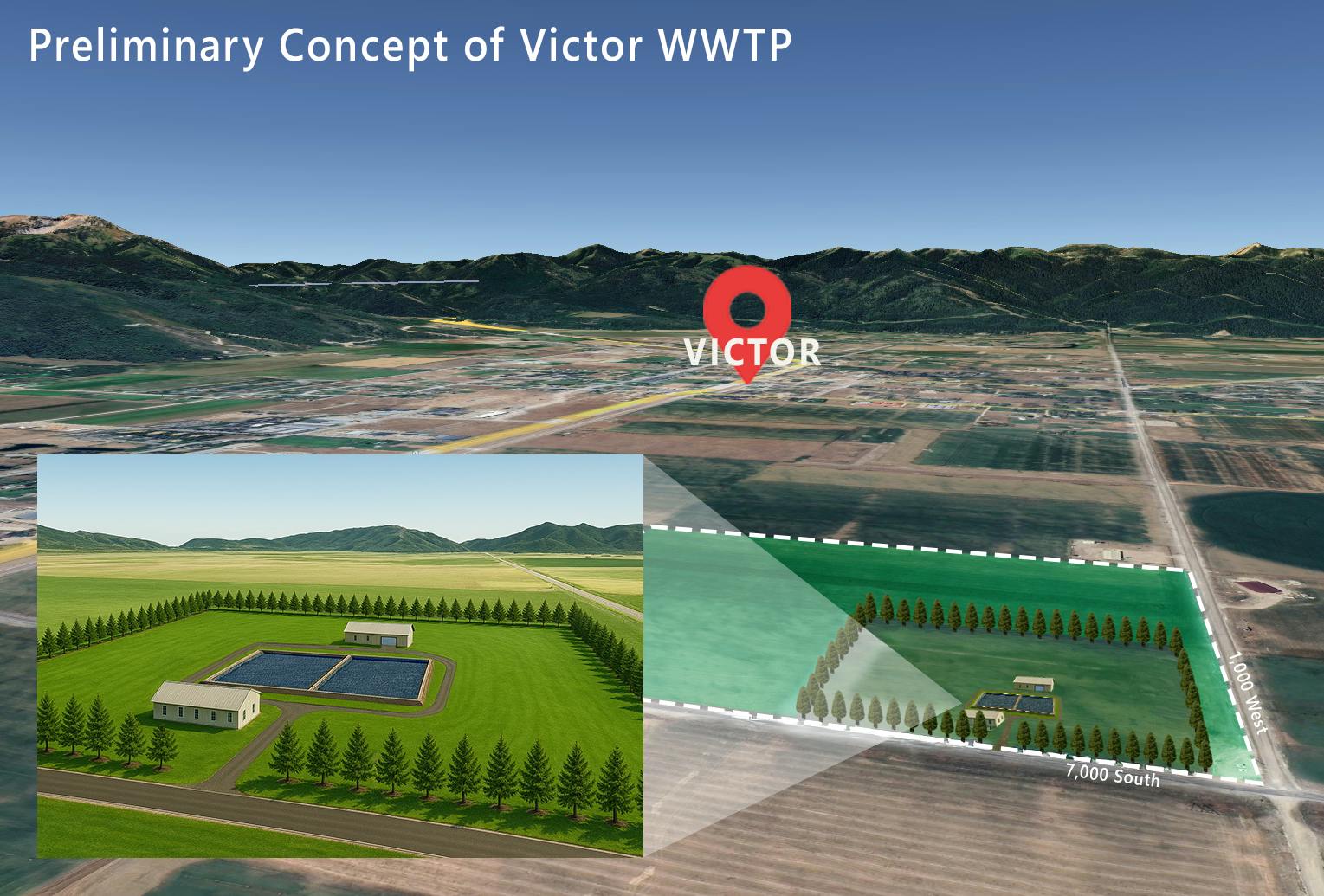
Following the decision, Victor took decisive steps toward self-sufficiency. In August 2025, the city entered a contract to purchase a 40-acre parcel of land to serve as the site for its new wastewater treatment facility. Driggs has agreed to continue treating Victor's wastewater until at least January 2029, allowing Victor time to complete construction of its new plant. This major infrastructure investment is a pivotal moment for Victor, shifting its wastewater management from a customer-model to a local asset under its own control.
Meeting links and staff reports for the March and August 2025 mentioned above are located in the City Council Meeting Links Tab below. It also includes all meetings where actions regarding the WWTF will be cataloged.
Teton Valley News Article about the Council Vote to begin the process of building a Wastewater Treatment Plant for the City of Victor.
Teton Valley News Article regarding the plan to purchase land for use of the WWTF.
All items below are linked:
By clicking on the date it will take you to the agenda
By clicking on the text it will take you to the staff report or materials
By clicking on the vote results it will take you to the minutes from that meeting.
2024 meetings with wastewater related items on the agenda.
April 18, 2024 - Task order for Sunrise Engineering for Wastewater Treatment Plant Feasibility Study - Approved 4-0
June 26, 2024 - Land Application Feasibility Study and Wastewater Treatment Facility Decision - Approved 3-0
In 2025, the Victor City Council was scheduled to meet 26 times, out of these meetings there was something wastewater related on the agenda for 13 of those meetings.
February 26, 2025 - Wastewater Treatment Plan Work Session - No Action needed
March 12, 2025 - Wastewater Facility Planning Study - Presentation - Approved 3-0
March 27, 2025 - Victor Wastewater Facility Alternatives - Approved 3-0
May 14, 2025 - Service Agreement with Altura for Financial Consulting - Approved 3-0
May 22, 2025 - Spring Retreat Work Session WWTF Alt Delivery Methods - No Action Needed
July 9, 2025 - Sunrise Engineering Work Order for Professional Land Surveying - Approved 4-0
August 27, 2025 - Property Purchase and Sale Agreement - Approved 3-0
October 8, 2025 - Agreement with MSBT Law for Bond Counsel Services - Approved 3-0
Proposal for Municipal Advisory Services - Zions Public Finance - Approved 3-0
October 14, 2025 - Fall Retreat Work Session WWTF Finance Methods - No Action Needed
October 22, 2025 - Professional Services Agreement for Engineer - Approved 3-0 (see RFP information in the drop downs below)
November 12, 2025 - Public Hearing for Judicial Confirmation-Stephanie Bonney-MSBT Law - No Action Needed
November 12, 2025 - Contract for Municipal Advisory Services - Approved 2-1
November 13, 2025 - Public Hearing for Annexation and Rezoning of land for WWTF site (see application information in the drop downs below) - Continued to December 10, 2025
December 10, 2025 - Resolution R587 - Judicial Confirmation - Continued to January 14, 2026
December 10, 2025 - Public Hearing for Annexation and Rezoning of land - Continued to January 14, 2026
2026 meetings with wastewater related items on the agenda.
January 14, 2026 - Resolution R587 - Judicial Confirmation
January 14, 2026 - Public Hearing for Annexation and Rezoning of land
The Request for Qualifications for Engineering Design Services for a New Wastewater Treatment Plant is closed. A Selection Committee reviewed all submissions and rank them. They presented their ranking to Council Council for selection and contract. Sunrise Engineering has been contracted to be the engineer for this project.
October 22, 2025 Professional Services Agreement by City Council
The City is under contract for the purchase of land that is currently outside City limits but is immediately adjacent. Before the property can be developed it will require an annexation and rezoning.
Staff has preparing the required materials for the Annexation/Rezoning application. The portion of the site to be purchased by the City will be requesting a CIV zoning district, the owner has requested RS-16 for the remainder of the property.
LU2025-10 Application Material
October 16, 2025 - Planning and Zoning Commission Public Hearing
November 13, 2025 - City Council Public Hearing
December 10, 2025 - City Council Public Hearing
January 14, 2026 - City Council Public Hearing
Findings
Ordinance O645 - Recorded as Instrument #
Annexation Plat - Recorded as Instrument #
Once the annexation is approved the City will process an application for split a lot. This is because the property as a whole is currently larger than the portion the City is hoping to purchase. The property will need to be divided so there are two parcels, one of which the City will ultimately be purchasing and the other will remain under the ownership of the current owner. The parcel is currently 80 acres and each new parcel will be approximately 40 acres.
SD2025-08 Application Material
Notice of Decision
Evens Subdivision Plat - Recorded as Instrument #
Once the engineer is selected and under contract they will work towards developing the design of the wastewater treatment facility, determining how it will function, designing the facility and its layout, and obtaining all environmental approvals, and construction permits.
Once the design is nearing 30% the City will prepare an application for Conditional Use Permit. The Land Development Code defines a wastewater treatment facility as a Major Utility which requires a conditional use permit in the CIV zoning district.
The Planning and Zoning Commission will hold a public hearing to decide on the conditional use permit. This is anticipated for sometime between March and May.